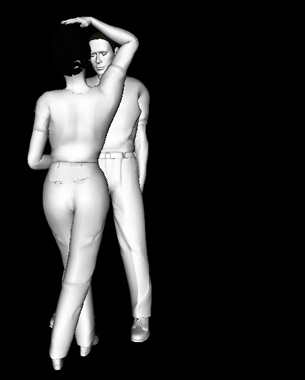
The difference between Virtual Reality and Augmented Reality is that the first one replaces everything you see (and hear, sometimes) with a virtual world, while in Augmented Reality you “superimpose” virtual elements onto your real world surroundings using goggles or a display/camera combo of some kind.
During my studies I took this course and it was really cool to learn about this technology involving motion tracking, VRML modeling and designing. We were given the opportunity to work on our own ideas and to try to utilize VR technology as much as possible. For presentation use, there were immersive curved displays with stereoscopic projectors and surround sound…
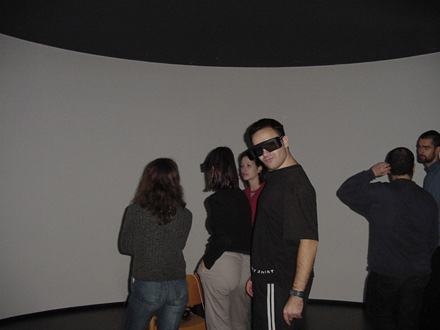
…or the Automatic Virtual Enviroment “CAVE” with 4 virtual sides of a cube with perfectly blended edges, so you cannot notice where the floor ends and the wall begins. Some CAVE systems even have all 6 sides in which you can immerse.
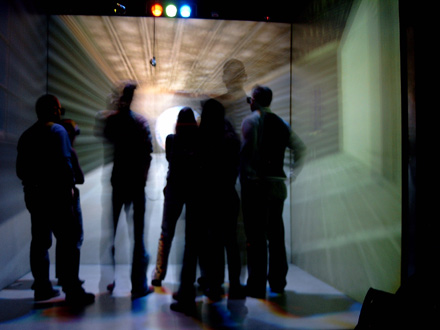
Now on to the project.
Since I didn’t know how to (ballroom) dance and this being a rather needed skill when living in Austria, I imagined a system that could teach me to do exactly that; waltz, bossa, cha-cha, tango, rumba, samba – if you can name it, you can learn it 🙂
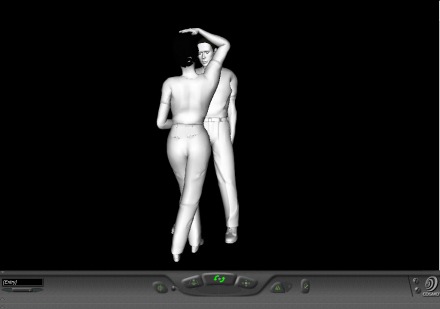
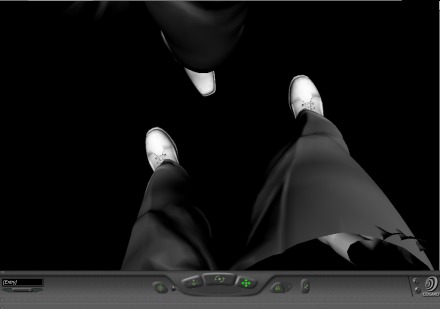
In a short period of time, I designed the basic functionality of this system. So, obviously the feet were the center of your attention (at the beginning). In the VR you could see your virtual legs being motion-tracked at the millimeter position through reflective markers. The second pair of shoes that are synced to the music played were the ones you should follow until you feel confident enough to perform the steps without the music pausing or slowing down in between, waiting for you to position yourself correctly.
In the advanced version, a virtual partner could be introduced, whereby your complete body should be tracked for the upright stance and upper body training.
